
Two RFO volunteers, Sophie Qin and Rachel Freed, have submitted a research paper to the Journal of Double Star Observations (JDSO) presenting new astrometric measurements of the double star system WDS 18428+5938 ” a pair of stars that have been watched by astronomers for nearly two centuries.
A Star System with a Long History
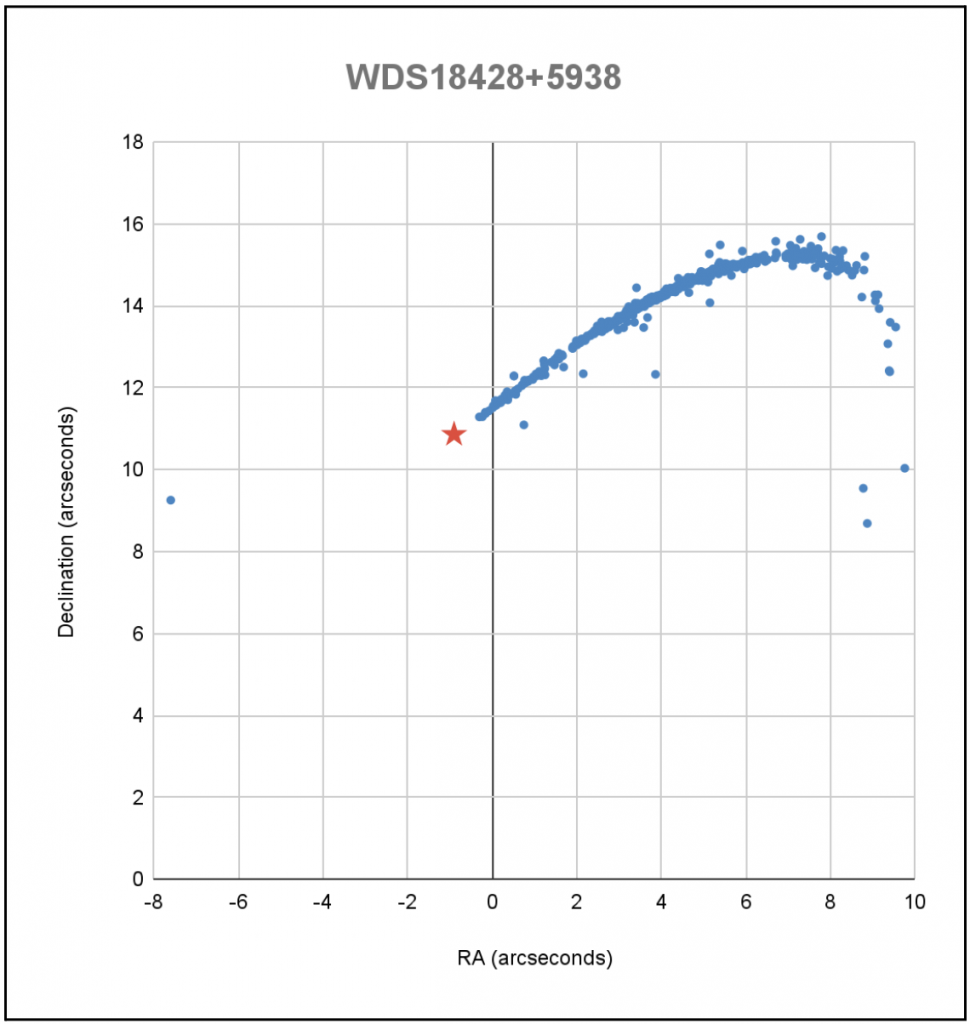
WDS 18428+5938, also catalogued as STF 2398 AB, sits in the constellation Draco and was first recorded by Russian astronomer Friedrich Georg Wilhelm von Struve in 1831. Since that initial observation, the system has been measured 641 times by astronomers around the world. Qin and Freed’s new observations add a 2025 data point to that long baseline ” and confirm that the system’s motion continues to follow its established orbital trend.
What makes this system particularly interesting is that both stars are red dwarfs, and both are known to host planets. The pair appears to be a true gravitationally bound binary rather than two unrelated stars that happen to lie along the same line of sight from Earth.
Confirming a Physical Pair
To verify that the two stars are physically associated ” and not just an optical alignment ” the authors turned to the European Space Agency’s Gaia Data Release 3, which provides exquisitely precise measurements of stellar distances and motions. Both stars showed nearly identical parallax values (indicating they are the same distance from Earth) and similar proper motions (indicating they are moving through space together). The minimum possible separation between them works out to roughly 136 AU ” well within the range of known physical binary systems. The Gaia data strongly support classifying WDS 18428+5938 as a true binary.
The Observations
Rather than using RFO’s own telescope, Qin and Freed accessed the Las Cumbres Observatory (LCO) global telescope network, obtaining ten five-second exposures through the McDonald Observatory node in Texas on November 14, 2025. They analyzed the images with AstroImageJ software, measuring the angular separation and position angle of the two stars in each frame.
Their results were precise and consistent across all ten images:
- Position angle: 184.74° (standard deviation of just 0.074°)
- Separation: 10.90 arcseconds (standard deviation of 0.021″)
For context, the system’s position angle was 136° and its separation was 14.0 arcseconds when Struve first recorded it in 1831. The stars have been slowly moving relative to each other ever since ” and Qin and Freed’s 2025 measurement fits neatly into that long arc of motion.
Read the Paper
The paper has been submitted to the Journal of Double Star Observations. A link to the published version will be added here once it is available.
Congratulations to Sophie Qin and Rachel Freed on an excellent piece of research, and on adding a new chapter to a story that astronomers have been following since 1831.