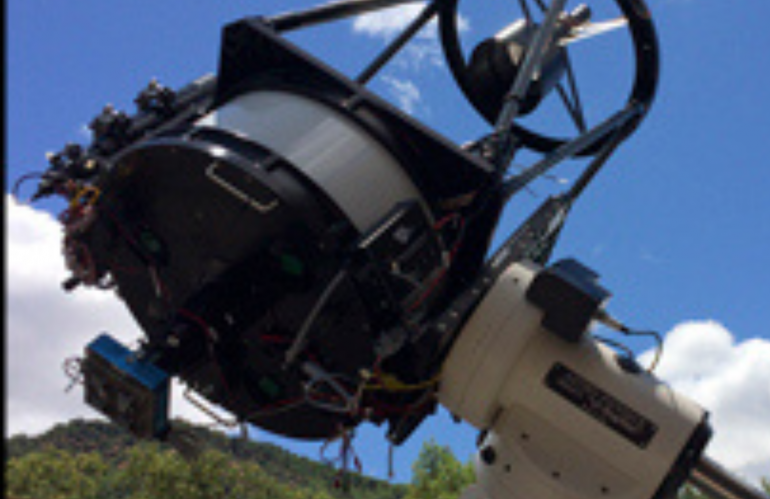
The year 2025 marked a turning point for RFO’s research program. The Research Committee transformed the RC20 telescope from a capable but manually operated instrument into a fully automated research platform, expanded into two new scientific disciplines, and established formal structures that have made the program more productive, more accessible, and more capable of producing publishable results. The science image count grew from 5,686 in 2024 to 9,294 in 2025, across 103 observing nights compared to 78 the previous year.
Automation: The RC20 Becomes a Research Platform
The biggest operational change of 2025 was the full deployment of NINA (Nighttime Imaging ‘N’ Astronomy) on the RC20. NINA replaced the patchwork of manual and semi-manual workflows that had previously governed observing sessions. With NINA in place, each night’s session is fully automated: the system selects targets, sequences exposures, auto-focuses, plate-solves to verify pointing, executes closed-loop slews to center targets precisely, and runs post-sequence calibration. Completed, calibrated science images are automatically ingested into imagelib.rfo.org and are ready for analysis.
A formal NINA Research Checklist and operator training guide were developed and refined through use, enabling a growing pool of qualified observers to run research-grade sessions consistently. Hardware improvements to guiding, backlash reduction, and polar alignment further improved data quality. The system also demonstrated new capabilities, including tracking moving targets ” the committee imaged Comet C/2025 R2 ” and acquiring the high-volume image sets required for speckle interferometry.
New Scientific Capabilities
2025 saw RFO break into two new areas of astronomy that had previously been out of reach.
Spectroscopy arrived at RFO when a Star Analyzer slitless spectroscope achieved first-light results on the RC20. Spectra reveal the chemical composition, temperature, and motion of stars directly from their light. The committee began characterizing the instrument’s performance, opening a research avenue that goes well beyond photometry.
Speckle interferometry was established as a viable technique on the RC20. This method involves acquiring thousands of very short exposures and computationally combining them to overcome atmospheric blurring ” enabling very close double stars to be resolved and measured that would otherwise blur together into a single point of light. RFO successfully resolved double stars with separations consistent with published catalog values.
Photometric transformation coefficients were also derived for the RC20, meaning that RFO’s BVRI photometric measurements are now calibrated to international standard fields and directly comparable to data from other observatories worldwide. This is a prerequisite for high-quality data submissions to the AAVSO.
Variable Star Research
Active variable star programs produced substantial results. Contact binary stars ” systems so gravitationally close that the two stars share an outer atmosphere ” were the most intensively observed targets. RW Com, NS Dra, and V2552 Cyg each were imaged hundreds of times, and their light curves were modeled using PHOEBE software. Long-term monitoring continued for the RV Tauri candidate stars NP Cam, V1226 Her, and AC Her.
The ongoing Z UMi campaign, which had begun tracking a dramatic brightness decline in September 2024, reached a significant milestone in 2025 as the star recovered to near normal brightness ” and then unexpectedly began a second decline sooner than expected. RFO data on both V-band and I-band magnitudes revealed non-synchronous behavior between brightness and the V-I color index, a finding the committee considers potentially publishable.
Other Research
Exoplanet transit research continued in 2025 using TESS (Transiting Exoplanet Survey Satellite) candidate targets, with analysis performed using AstroImageJ and results compared to published transit parameters.
In August 2025, RFO observers documented the appearance of a supernova in the nearby spiral galaxy NGC 7331. Designated SN 2025rbs, the supernova was bright enough for the RC20 to track its light curve through the decline phase ” a rare opportunity for citizen science contribution during a transient event.
Double star observations and analysis were done at RFO and using the Las Campanas Observatory remote telescope network, resulting in preparation for a publication in the Journal of Double Star Observations.
Research Structure and Student Engagement
Inspired by best practices shared at the Society for Astronomical Sciences annual conference, the Research Committee adopted a team-based research model: small groups of 3–4 people organized around specific projects, with assigned mentors and dedicated writing time. Active teams are now studying eclipsing binary stars, exoplanet transits, double star astrometry, speckle interferometry, photometric transformation, and spectroscopy.
Student engagement reached new levels. High school and college students participated in data acquisition, analysis, and paper writing, with several projects advancing to submission or near-submission in JAAVSO and the Journal of Double Star Observers. Buckingham Charter School made a field trip to the observatory as part of their Research Fridays on eclipsing binary stars, and Dr. Rachel Freed taught both RR Lyrae and double star classes that produced active student researchers.