2024 was a year of firsts and dramatic moments for the RFO Research Committee. The
team quadrupled its image output over 2023, capturing more than 3,000 science images
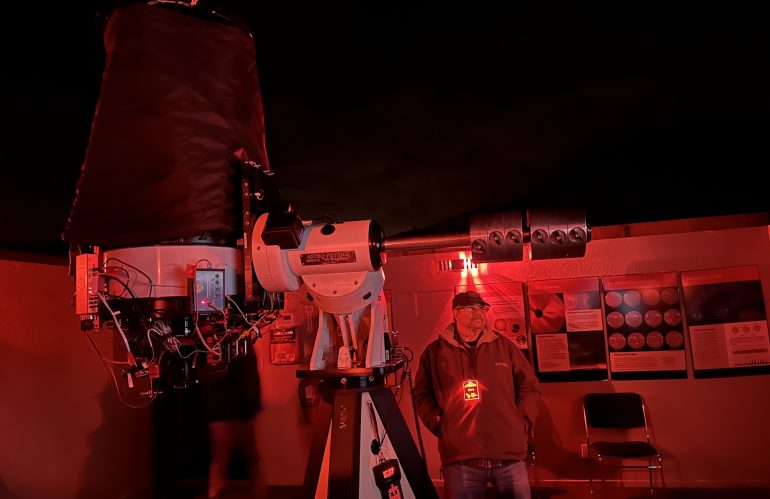
across 78 observing nights. New cameras went into service on the RC20, exoplanet
transits were successfully observed for the first time, and in September a closely watched
variable star began one of the deep brightness drops that define its rare type ” an event
RFO observers were positioned to document from beginning to minimum.
Observing Program
The committee maintained a target list spanning cataclysmic variables, R Coronae Borealis stars, Cepheid variables, and exoplanets. With over 3,000 science images taken, observing activity quadrupled compared to 2023. The top targets by image count included three exoplanet systems, the R Coronae Borealis variable Z UMi, and several cataclysmic variables.
AAVSO members can request observations through the AstroNet network, which provides access to telescopes maintained by other AAVSO members. In 2024, Z UMi was accepted as an AstroNet target, and images taken during the dimmest part of the star’s cycle were provided to an RFO researcher for analysis.
First Exoplanet Transits
The headline achievement of the year was the successful completion of RFO’s first exoplanet transit campaigns. Judd Reed, George Loyer, and Gordon Spear planned and executed a series of campaigns using prediction tools from the NASA Exoplanet Archive, a Czech exoplanet predictions site, and the Swarthmore TAPIR program. Three campaigns collected complete transit light curves for HAT-P-20b, XO-7b, and XO-1b ” each showing the subtle dimming, about 0.02 magnitudes, caused by a planet crossing in front of its star. Spear performed the photometric analysis and wrote up the results in papers published on the RFO website. See the separate blog on this work for more detail.
Z Draconis: Watching an Eclipsing Binary
John Gregg spent the year observing Z Draconis, an Algol-type eclipsing binary star,
building a light curve that captured an eclipse of this two-star system. His goal is to
compare the current eclipse period to historical measurements made by an observer in 1912
and determine whether the orbital period has changed over more than a century. This
long-baseline comparison is a form of research that is uniquely suited to amateur
astronomers who can track targets consistently over many months.
Z Ursa Minoris: Catching a Magnitude Drop in Real Time
The most dramatic observational result of 2024 was the tracking of Z Ursa Minoris (Z UMi) through a deep fade event. This R Coronae Borealis variable ” a rare type of star that experiences unpredictable, sudden brightness drops caused by the condensation of carbon dust clouds in its atmosphere ” had been monitored routinely throughout the year.
In September 2024, Z UMi began dropping in brightness, and it quickly became clear this was a major event. Over the following months the star fell nearly 7 magnitudes from its normal brightness, reaching its minimum in December before beginning to recover. RFO observers adjusted their exposure times and imaging cadence as the star faded to maintain usable data quality for reporting to the AAVSO. Crucially, RFO was the only observatory submitting measurements in the infrared I-band filter alongside the standard visual V-band data. As the star dimmed, the difference between V and I magnitudes increased ” the infrared faded less than the visual light ” consistent with the carbon dust origin of the event, since carbon dust clouds block visible light more than infrared.
New Instrumentation
Both cameras funded by 2023 grants were installed in January 2024 and commissioned over the following months. The ZWO ASI2600 Pro cooled monochrome camera (“MoCa”) replaced the Atik16000 at the RC20’s filter wheel. The ZWO ASI294MC Pro color camera (“CoCa”) was installed on a secondary instrument port for use at public events. The RC20’s control computer was upgraded from an Eagle 4 to a faster Eagle 5, and the 64-bit version of SkyX was installed and configured. The committee also secured a grant for a new Boltwood weather sensor, to be installed in 2025.
Gordon Spear completed the calibration image work for 2023 data and George Loyer designed a Python pipeline for automated calibration of science images within 24 hours of acquisition ” development slated to begin in 2025.
Student Research
Five students from Dr. Rachel Freed’s Fall 2023 Double Star Science class published their paper on double star system WDS 22267+4433 ES 1346 AC in the Journal of Double Star Observers. A Fall 2024 class produced a new team of three students working on a paper about WDS 04192+6135, expected to be published in early 2025.
Multiple Research Committee members collaborated with teacher Robby Tabor at Buckingham Charter School on his Astronomy 101 class, which included 11 Research Fridays ” hands-on sessions in which students worked directly with astronomical data.