
R Coronae Borealis (RCB) stars are among the rarest objects in the sky. These hydrogen-deficient supergiant stars ” fewer than 150 have been confirmed in our entire galaxy ” experience dramatic and unpredictable brightness drops, sometimes fading by seven or eight magnitudes over just a few weeks. The cause is striking: clouds of carbon dust condense in the star’s outer atmosphere, obscuring its light much as a sudden fog would dim a distant lighthouse. The dust is also the reason RCB stars glow unusually brightly in infrared wavelengths: the carbon dust re-radiates energy it absorbs as infrared light, making these stars stand out clearly above ordinary stars when observed with infrared instruments.
A research team at RFO set out to confirm this infrared excess using a novel approach. Rather than making new telescope observations, researcher George Loyer and high school student Adithya Vasudavan turned to publicly available astronomical survey databases. Their work spanned 2022 through 2024 and resulted in a paper submitted to the Journal of the American Association of Variable Star Observers (JAAVSO).
The Approach
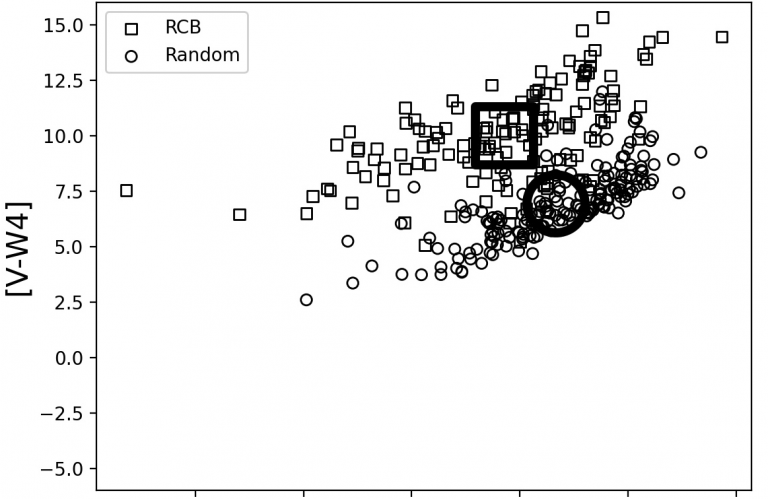
The team extracted infrared brightness measurements for all known RCB stars from two major survey catalogs: 2MASS, which mapped the sky in near-infrared J, H, and K bands, and AllWISE, which surveyed in mid-infrared W1 through W4 bands. For comparison, they assembled the same measurements for a random sample of 200 stars from the same databases. Vasudavan wrote a Python program to plot the data as scatter charts comparing infrared brightness to visible brightness.
The Result
The scatter plots showed a clear and consistent result: across multiple infrared bands, RCB stars are significantly brighter relative to their visual brightness than the comparison population of ordinary stars. The infrared excess is visible as a distinct clustering of RCB data points away from the main distribution of normal stars ” an independent, data-driven confirmation of a known property of this class of variable, using publicly available survey data.
Status
The paper was submitted to JAAVSO and was accepted for peer review. Reviewer feedback requested additional context placing the findings within the broader scientific literature on RCB infrared excess, particularly the foundational work by Feast and Glass (1973). Those revisions are in progress.
This project illustrates one of the distinctive strengths of the RFO research program: meaningful, publishable science is possible without exclusive access to large professional telescopes. The raw material was in public archives; the contribution was the analysis, the comparison, and the presentation.