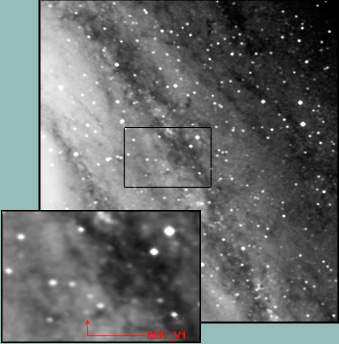
In October 1923, Edwin Hubble sat at the eyepiece of the 100-inch Hooker Telescope on Mount Wilson and photographed a small section of the Andromeda Nebula ” a fuzzy patch of light whose nature had been debated for years. When he examined his plates carefully, he identified a particular kind of pulsating star called a Cepheid variable, and that discovery settled one of the great controversies in the history of science.
Cepheid variable stars brighten and dim in a reliable cycle. The period of that cycle is directly related to the star’s true luminosity ” how intrinsically bright it is. By measuring how long the cycle takes and comparing the star’s apparent brightness to what its period predicts, astronomers can calculate precisely how far away it is. When Hubble applied this calculation to the Cepheid in Andromeda, now designated V1, the result was unambiguous: the star ” and the galaxy around it ” lay far beyond the boundaries of our own Milky Way. What had seemed like a nearby nebula was in fact a separate island of hundreds of billions of stars, millions of light-years distant.
In 2010 and 2011, observers at Robert Ferguson Observatory took on the challenge of observing this same star using the RC20, RFO’s 20-inch Ritchey-Chrétien research telescope. Imaging a Cepheid variable in another galaxy requires reaching faint magnitudes over multiple observing sessions, tracking brightness changes across a cycle that spans days to weeks. This project demonstrated that the RC20 ” operated by trained volunteer observers ” is capable of exactly this kind of research.
The M31 Cepheid project stands as one of the earliest examples of what the RFO research program has continued to build on: the idea that an amateur telescope, operated with professional-grade technique and attention to detail, can do meaningful observational astronomy.