The RFO Research Committee was founded in the spring of 2021. By 2023, it had grown into a functioning research organization with regular observing sessions, active software development, new instrumentation, student research partnerships, and an in-progress publication. This report summarizes the work of the committee across 2023 ” a year of building foundations.
Observations and Light Curves
The committee maintained a target list of variable stars for regular monitoring, with a focus on cataclysmic variables (CVs) and R Coronae Borealis (RCB) stars. A total of 817 science images were taken across multiple observing sessions during the year. Observers used both the RC20 at RFO and remote telescope time at Las Campanas Observatory (LCO), made available through a grant held by Dr. Rachel Freed.
John Gregg used differential photometry with JS9 software to produce light curves for two cataclysmic variables: SS Cygni, a prototype dwarf nova that brightens by four magnitudes every seven or eight weeks; and Z Camelopardalis, a prototype Z Cam-type variable whose light curve showed evidence of at least three outburst events.
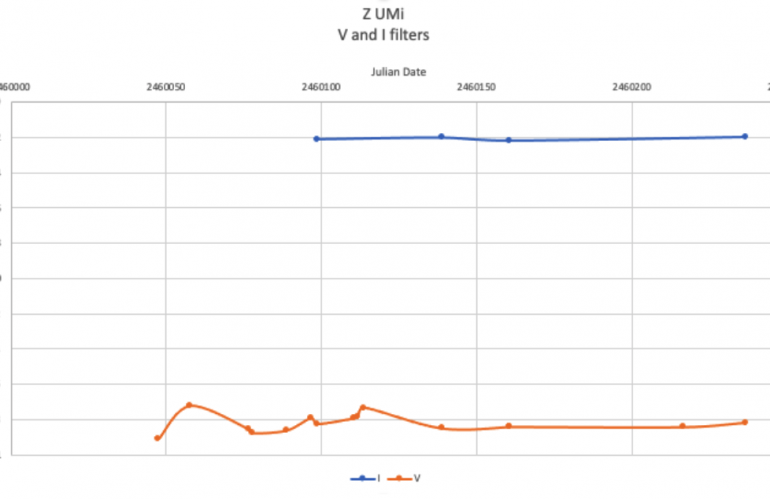
George Loyer produced a light curve for Z Ursa Minoris (Z UMi), an R Coronae Borealis variable, using the AAVSO VPhot software on 117 images spanning April through October. The V-band light curve showed brightness variations consistent with other RCB stars in quiescent periods ” amplitude swings of about 0.2 magnitudes with periods of 40–50 days. An interesting result was that the infrared I-band measurements showed relatively little variation, consistent with the known infrared brightness of RCB stars due to their surrounding carbon dust clouds.
Instrumentation: Two New Cameras and a New Filter Wheel
Thanks to a $3,000 grant from the New York Community Trust, the committee purchased a ZWO ASI2600 Pro cooled monochrome CMOS camera ” a major upgrade over the existing Atik16200, offering quantum efficiency of 92% compared to 48%. Installation was planned for early 2024 once calibration work with the Atik16200 was complete.
Docents raised about $950 to purchase a ZWO ASI294MC Pro color camera for use during public star parties. The color camera was installed in December 2023 and operator instructions were updated for its use. A new filter wheel also replaced the original unit, which had suffered from persistent intermittent failures.
The committee began formal planning for adding spectroscopy capability to the RC20, with George Loyer and Gordon Spear developing a proposal around the Shelyak motorized UVEX spectrograph.
Calibration Work
One of the year’s persistent technical challenges was obtaining high-quality calibration frames ” the bias, dark, and flat images used to remove instrument artifacts from science data. A bug in the Atik16200 caused the shutter to admit stray light during dark frames. Through careful experimentation, the team finally achieved clean dark images in December 2023, enabling the backlog of 2023 science images to be properly calibrated.
Software: ImageLib
Dave Kensiski released the first version of ImageLib in July 2023 ” a web application at imagelib.rfo.org that makes all images taken on the RC20 searchable and downloadable by anyone with an RFO Google account. Users can search by partial object name, date range, and image type. The tool proved immediately essential for researchers working remotely on photometry. Judd Reed separately wrote a custom Python program for differential photometry that could process raw images, locate comparison stars, and produce a light curve in a single automated pass.
Training
Gordon Spear led multiple training sessions on differential photometry with JS9, as well as sessions on calibration frame theory and astronomical spectroscopy basics. George Loyer completed AAVSO CHOICE courses on VPhot and variable star light curve classification. Multiple members attended AAVSO webinars on variable star measurement techniques.
Student Research
Two students from Marin Academy ” Noah Laney and Hayden Stone ” produced a short Z UMi light curve using LCO images and JavaScript photometry tools, presenting the results to their class for a senior project requirement. A high school student from Colusa undertook a project on light pollution’s impact on astronomy and ecosystems, extending into spring 2024.
George Loyer and high school student Adithya Vasudavan submitted a paper to JAAVSO on confirming infrared excess in R Coronae Borealis stars using publicly available infrared survey data. The paper passed peer review and was under revision at year’s end.