
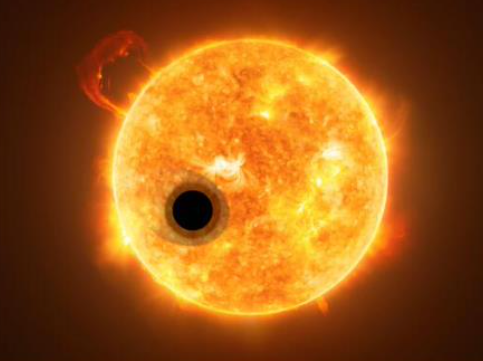
One of the most powerful methods for detecting planets around other stars is also one of the most elegantly simple: when a planet passes directly in front of its host star from our perspective, the star dims very slightly ” typically by less than one percent ” for a predictable period of time. The dimming is tiny, but it is precisely measurable with a research-grade telescope and careful photometric technique. This is the transit method, and it has been used to confirm the existence of thousands of exoplanets.
In the spring of 2024, RFO researchers Judd Reed, George Loyer, and Gordon Spear organized and executed RFO’s first exoplanet transit observing campaigns ” a milestone for the observatory’s research program.
Planning the Campaigns
Using prediction tools from three online sources ” the NASA Exoplanet Archive, a Czech
exoplanet transit prediction site, and the Swarthmore TAPIR (Transit and Ephemeris
Service) program ” the team identified upcoming transit windows for several known
exoplanet systems visible from RFO. Capturing a full transit requires keeping the telescope
trained on a single star for several continuous hours, often most of a night, to record
the star’s brightness before the transit begins, through the dimming, and after the planet
has crossed and the star has returned to normal brightness.
The Results
Weather interfered with several planned campaigns, but three sessions succeeded. RFO observers recorded complete transits for three confirmed hot Jupiter exoplanets: HAT-P-20b, XO-7b, and XO-1b. In each case, Spear performed photometric analysis using AIP4WIN software, measuring brightness changes on the order of 0.02 magnitudes ” the clear but subtle signature of a planet crossing a stellar disk. He also wrote up the analysis for each exoplanet in RFO Research Notes.
The results were not without surprises. The XO-7 transit did not end when the predictions said it should, and follow-up observations the next night showed the star had still not returned to its expected brightness ” an anomaly worth investigating further. The XO-1 transit produced a clean light curve except for an unexpected brightness bump on the rise that theory doesn’t predict. These small deviations from the models are precisely the kind of data that keep exoplanet science interesting, and they illustrate why independent observations from multiple sites around the world matter.